Mastering Your Health Routine: The Essential Guide to Vitamin, Supplement, and Medication Logs
In the pursuit of better health, consistency is often the missing link between intention and results. Whether you are managing a chronic condition, optimizing athletic performance, or simply trying to maintain baseline wellness, the sheer volume of daily inputs can be overwhelming. This is where the humble vitamin, supplement, and medication log becomes an indispensable tool. Far from being a mere administrative chore, tracking your intake is a foundational practice that bridges the gap between medical advice and real-world application.
Understanding why and how to track your regimen is just as important as the act itself. In our modern, fast-paced lives, memory is a fallible metric for health management. A dedicated notebook designed specifically for this purpose transforms abstract health goals into tangible, actionable data. By exploring the significance of these logs, we can uncover how they fit into broader contexts of personal care, medical collaboration, and mindful living.
The Science of Consistency in Treatment and Supplementation
To understand the value of a tracking system, one must first understand the biological necessity of consistency. Unlike acute treatments that offer immediate relief, vitamins, supplements, and many maintenance medications operate on a cumulative basis. Nutrients like Vitamin D, Magnesium, or Omega-3 fatty acids require steady levels in the bloodstream to produce noticeable benefits. Similarly, prescription medications often have a therapeutic window that relies on precise timing.
When doses are missed or taken erratically, the body struggles to maintain homeostasis. For example, skipping a dose of a blood pressure medication can cause rebound hypertension, while inconsistent probiotic use may fail to establish a stable gut microbiome. A vitamins, supplements, and medication log serves as an external accountability partner. It removes the cognitive load of remembering "Did I take that already?" and replaces anxiety with verification. This simple shift allows the user to focus on how they feel rather than worrying about whether they adhered to their protocol.
Bridging the Gap Between Patient and Provider
One of the most underappreciated aspects of maintaining a detailed log is its utility in clinical settings. Doctors and healthcare practitioners rely heavily on patient reporting to adjust treatments. However, human memory is notoriously unreliable when recalling specific details over weeks or months. Patients often unintentionally minimize side effects or forget instances of non-compliance.
A well-maintained log provides objective data that enhances the quality of care. When you bring a record showing four weeks of consistent adherence alongside notes on persistent symptoms, your provider can make informed decisions about dosage adjustments or alternative therapies. Conversely, if the log reveals gaps in usage, the conversation can shift to addressing barriers to adherence rather than assuming treatment failure. This collaborative approach empowers patients to take ownership of their health journey while providing clinicians with the evidence needed to optimize care.
Design Features That Support Daily Adherence
Not all trackers are created equal. The effectiveness of a log depends largely on its usability. If a system is too complex, it becomes another source of stress; if it is too vague, it fails to capture necessary data. An efficient notebook strikes a balance between structure and flexibility. Key design elements facilitate long-term habit formation:
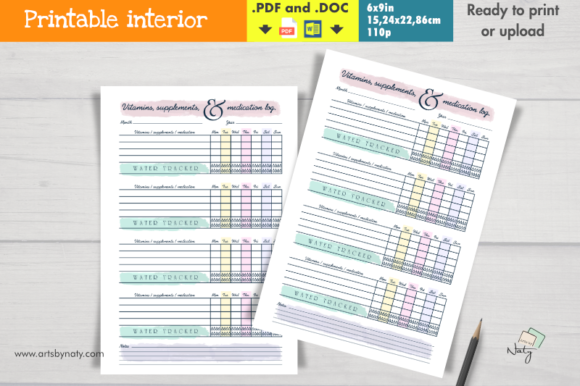
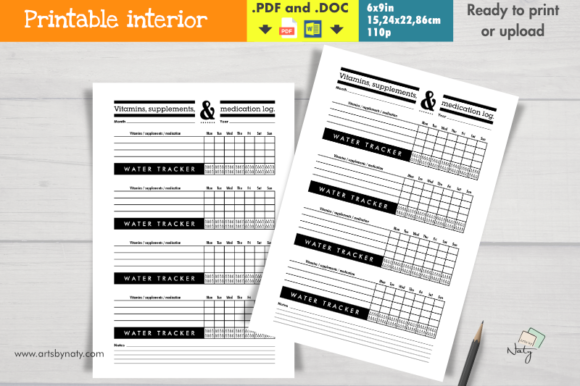
- Four Weeks Per Page Layout: Seeing an entire month at a glance allows users to identify patterns immediately. You can visually spot streaks of success or recurring days where adherence drops, such as busy weekends or travel days.
- Water Consumption Tracker: Hydration is critical for the absorption of water-soluble vitamins and the metabolism of medications. Tracking up to eight glasses per day ensures that supplementation is supported by adequate fluid intake, reducing the risk of gastrointestinal irritation.
- Dedicated Notes Section: Health is holistic. A space for notes allows you to correlate intake with outcomes. Did you feel more energetic after increasing B12? Did a new supplement cause stomach upset? These qualitative insights are just as valuable as the checkmarks.
- Portable 6x9 Inch Size: Habits are built through environmental cues. A compact size (15.24 x 22.86 cm) means the log can live on a nightstand, in a purse, or next to the medicine cabinet, serving as a constant visual reminder.
Versatility Across Lifestyles and Professions
The application of a vitamin, supplement, and medication log extends far beyond personal health management. Its utility spans various demographics and professional fields, adapting to unique needs and workflows.
Caregivers and Family Management
For those caring for children, elderly parents, or partners with complex regimens, a centralized log is a safety mechanism. It prevents double-dosing in households with multiple caregivers and ensures continuity of care during shift changes. The notes section becomes a communication channel between family members, documenting reactions or behavioral changes that might otherwise go unnoticed.
Health Coaches and Wellness Professionals
Professionals in the wellness industry often recommend supplements as part of a broader lifestyle plan. Providing clients with a structured tracker demonstrates professionalism and reinforces compliance. The included digital files (PDF and DOC formats) allow coaches to customize the interior before printing, adding their branding or specific protocols. The bonus A4 printable version is particularly useful for creating client handouts or wall charts in clinical settings.
Biohackers and Data-Driven Enthusiasts
For individuals experimenting with nootropics, adaptogens, or performance enhancers, correlation is key. These users treat their bodies as laboratories. The at-a-glance layout facilitates rapid pattern recognition, helping users isolate variables. When combined with other biometric data, the log helps distinguish between placebo effects and genuine physiological responses.
Addressing Common Misconceptions About Tracking
Despite the clear benefits, some individuals resist using a log due to common misunderstandings. Clarifying these assumptions is essential for broader adoption.
Misconception: Tracking is only for people with serious illnesses.
In reality, preventative health requires just as much discipline as reactive care. Maintaining optimal nutrient levels is an active process. Whether you are taking a single multivitamin or a complex stack, tracking reinforces the identity of someone who prioritizes their well-being.
Misconception: Digital apps are always superior to paper.
While apps offer automation, they also introduce screen time and notification fatigue. A physical notebook offers a tactile, distraction-free experience. The act of writing engages motor memory, reinforcing the habit neurologically. Furthermore, a paper log does not require batteries, updates, or internet access, making it reliable in any environment.
Misconception: Missing a day means failure.
A log should be viewed as a judgment-free zone. Gaps in the record are data points, not moral failures. They highlight areas where systems need adjustment. Perhaps the current time of day is unsustainable, or the pill size is difficult to swallow. The notes section is the perfect place to problem-solve these hurdles without self-criticism.
Maximizing the Value of Your Log
To get the most out of your vitamins, supplements, and medication log, consider integrating it into an existing routine. Habit stacking—pairing the new behavior with an established one—is highly effective. Place the notebook next to your coffee maker, toothbrush, or evening reading chair. Review the weekly spread every Sunday evening to prepare for the week ahead.
Utilize the notes section proactively. Don't wait for a doctor's appointment to write things down. Record energy levels, sleep quality, digestion, and mood daily. Over time, this creates a rich dataset that reveals the true impact of your regimen. Remember that the goal is not perfection, but awareness. Awareness leads to adjustment, and adjustment leads to optimization.
Technical Specifications and Practical Considerations
For those looking to implement this system, understanding the product specifications ensures it meets practical needs. The standard 6x9 inch format with 110 pages provides approximately three months of tracking, aligning with typical quarterly health reviews. The high-resolution 300dpi print quality ensures crisp lines and readable text, which is crucial for daily use.
The inclusion of both PDF and DOC files offers significant flexibility. The colored interior enhances visual organization, making different sections distinct and easier to navigate. The absence of watermarks ensures a professional appearance, whether for personal use or commercial distribution. The bonus A4 size caters to those who prefer a larger writing surface or wish to create wall-mounted trackers for visibility.
Conclusion: Empowering Health Through Organization
Ultimately, a vitamin, supplement, and medication log is more than a notebook; it is a commitment to self-care. In a world saturated with health information and product options, clarity is power. By externalizing the mental effort of tracking, you free up cognitive resources to focus on living well. Whether you are a patient navigating complex treatments, a caregiver ensuring safety, or an individual striving for peak performance, this simple tool provides the structure necessary for sustainable success.
Consistency is indeed key, but it is a key that must be forged through deliberate practice. With the right tools and mindset, anyone can transform their health routine from a source of stress into a pillar of stability. Start today, track honestly, and let the data guide you toward a healthier, more balanced life.