Retro Year Planner 1: A Full Year Guide to KDP Publishing and Personal Organization
The intersection of vintage aesthetics and modern productivity tools has created a significant niche in both digital planning and self-publishing. For creators, educators, and entrepreneurs, the Retro Year Planner 1 - Full Year represents more than just a scheduling tool; it is a comprehensive asset package designed for versatility. Whether the goal is to launch a low-content book on Amazon Kindle Direct Publishing (KDP) or to create a bespoke organizational system for personal or professional use, understanding the technical and aesthetic components of this template is essential. This resource bridges the gap between nostalgic design trends and the rigorous technical specifications required for commercial printing and digital distribution.
Navigating File Formats for Diverse Workflows
A primary advantage of the Retro Planner No. 1 ecosystem is its multi-format availability. Users are not locked into a single workflow but are instead provided with distinct file types that serve specific stages of production. Understanding when to utilize the PPTX versus the PDF or JPG assets is critical for efficiency.
The Role of Editable PPTX Templates
The inclusion of a 173-page PowerPoint (PPTX) file serves as the foundational master template. Unlike static PDFs, this format allows for deep customization without requiring advanced graphic design software like Adobe InDesign or Affinity Publisher. For business owners or educators looking to brand the planner, the PPTX format enables direct manipulation of the Slide Master. This feature ensures that global changes—such as swapping out the Gothic font for a corporate sans-serif or adjusting margin guides—propagate across all 12 months instantly. This editability transforms the product from a finished good into a flexible framework for unique derivative works.
Print-Ready PDF Variations
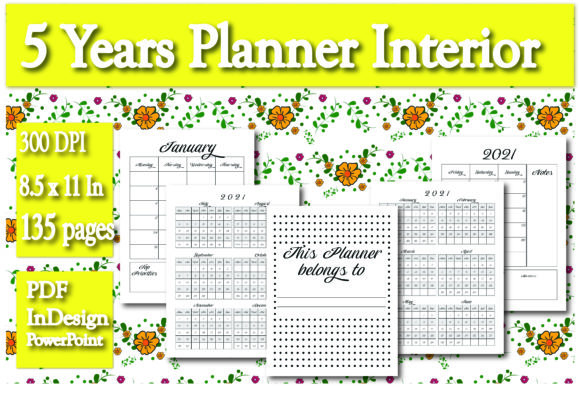
For those focused on immediate publication or high-fidelity digital use, the package includes three distinct PDF versions. These are pre-formatted for US Letter size (8.5 x 11 inches), which is the industry standard for many trade paperbacks and spiral-bound planners. The variations include:
- Gothic Font Edition: Maintains the original dark academia or vintage typographic aesthetic.
- NS Bullsmith Decorative Font Edition: Offers an alternative typographic texture for users seeking a different visual weight while retaining the retro structure.
- Holly Days Font Edition: Provides a seasonal or festive variation suitable for holiday-specific releases or gift-oriented products.
These PDFs are upload-ready, meaning the bleed, trim lines, and safe zones have been pre-calculated. This eliminates common rejection errors on KDP related to margin violations or text encroaching on the gutter.
Technical Specifications for Amazon KDP Success
Self-publishing requires strict adherence to platform guidelines. The Retro Year Planner 1 - Full Year is engineered specifically to meet Amazon KDP’s technical demands, reducing the friction often associated with formatting interior files. The most critical aspect of this preparation is the handling of bleed and image placement.
Understanding Bleed and Safe Zones
In professional printing, "bleed" refers to artwork that extends beyond the trim edge of the page to ensure no white borders appear after cutting. This planner template addresses bleed by centering page images within the document canvas. For KDP users, this centering is vital. It accounts for the mechanical variance in Amazon’s printing process, ensuring that decorative retro borders or background textures do not get inadvertently cropped or shifted into the binding gutter. By utilizing pre-centered JPG assets within the layout, creators mitigate the risk of receiving proof copies with misaligned interiors.
Font Licensing and Commercial Use
A nuanced consideration for KDP publishers involves typography licensing. While the editable PPTX includes Gothic fonts for design flexibility, it is important to note that KDP-ready book fonts are not embedded in the final distribution package for commercial embedding. This distinction protects users from potential copyright infringement. Publishers must either use the provided flattened PDFs (where fonts are rasterized or outlined) or substitute the editable fonts with open-source or commercially licensed alternatives if they choose to modify the text layers extensively. This separation encourages responsible publishing practices while still offering creative freedom.
Aesthetic Versatility and Market Positioning
The "Retro" designation covers a broad spectrum of visual styles. This planner leverages specific typographic choices to appeal to current market trends in stationery and digital planning. The use of Gothic and decorative serif fonts taps into the enduring popularity of Dark Academia, Cottagecore, and Victorian revival aesthetics. However, the utility of the Retro Year Planner 1 - Full Year extends beyond niche subcultures.
Adapting Vintage Styles for Professional Contexts
While the default styling is ornate, the underlying grid structure is universally functional. Researchers and academics often prefer retro-styled planners because the serif typography reduces eye strain during long study sessions compared to stark, minimalist modern designs. Similarly, professionals in creative industries may use the Holly Days or Bullsmith variations to signal approachability and creativity in client-facing planning tools. The ability to toggle between these three distinct typographic personalities allows a single base product to serve multiple demographic segments without requiring a complete redesign.
Modular Page Construction
The inclusion of individual page images in JPG format facilitates a modular approach to notebook creation. Rather than being forced to use the entire 173-page sequence, creators can curate custom compilations. A teacher might extract only the monthly overview pages and combine them with lined note-taking pages created elsewhere. A fitness coach could select specific tracking layouts and pair them with blank journaling spreads. This modularity is particularly valuable for creating niche-specific low-content books where relevance is more important than page count. By treating each page as an independent asset, the value proposition of the zip file increases exponentially.
Strategic Implementation for Creators and Educators
Beyond publishing, this planner serves as a practical operational tool. The 12-month readiness implies a full annual cycle, making it suitable for academic years, fiscal planning, or long-term project management.
Educational Applications
Educators can utilize the editable PPTX to customize lesson planning templates. The retro aesthetic can be engaging for students in history, literature, or art classes, serving as a thematic anchor for the curriculum. Because the file is editable, teachers can add specific grading rubrics, reading lists, or semester goals directly into the planner structure before printing or distributing digitally. The US Letter size is also compatible with standard classroom printers and binding machines, facilitating easy physical distribution.
Business and Research Organization
For researchers and business owners, the structured nature of a full-year planner provides necessary scaffolding for complex projects. The retro design elements offer a psychological break from the sterility of standard office software, potentially enhancing creativity and engagement with the planning process. When used as a KDP product, business coaches can create branded planners as lead magnets or course companions. The high-resolution nature of the included assets ensures that whether the planner is viewed on an iPad via GoodNotes or printed as a physical paperback, the legibility and visual integrity remain intact.
Optimizing the User Experience
To maximize the utility of the Retro Year Planner 1 - Full Year, users should adopt a systematic approach to file management and customization. Since all assets are delivered in a single zip file, establishing a clear folder hierarchy upon extraction is recommended. Separating the "Master Editable Files," "Print Ready PDFs," and "Individual Assets" prevents accidental overwriting of source materials.
When editing the PPTX, users should familiarize themselves with the Slide Master view immediately. Attempting to format pages individually is inefficient and prone to inconsistency. The Slide Master controls the recurring retro elements, headers, and footer positioning. Mastery of this feature reduces the time required to rebrand the planner from hours to minutes. Furthermore, when preparing files for KDP, always download the latest cover template calculator from Amazon to ensure the spine width matches the exact page count of the modified interior, as adding or removing modular pages will alter the physical dimensions of the final book.
Ultimately, this planner template functions as a hybrid tool. It satisfies the immediate need for a beautiful, functional organizational system while simultaneously providing the raw materials for commercial product development. By respecting the technical constraints of print publishing and leveraging the flexibility of editable formats, users can transform a single retro-themed asset into a diverse portfolio of products and personal productivity solutions. The fusion of Gothic typography with modern KDP compliance standards exemplifies how vintage design can be successfully adapted for contemporary digital and print markets.