Weight Lifting Logbook KDP Interior for Publishers
Creating a successful low-content book on Amazon requires more than just a catchy cover; the interior experience determines whether a customer leaves a five-star review or returns the product. For publishers targeting the fitness niche, a high-quality Weight Lifting Logbook KDP Interior is the foundation of a sustainable passive income stream. This specific digital asset package is designed to bridge the gap between amateur design attempts and professional-grade publishing standards. By providing pre-formatted, tested, and editable files, it allows creators to bypass the tedious technical setup and focus entirely on marketing and brand building.
Technical Specifications and File Integrity
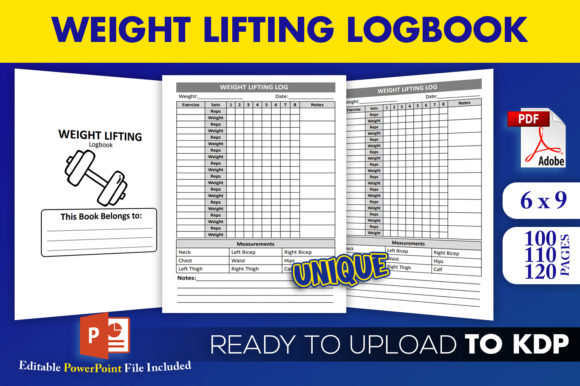
The primary anxiety for any KDP publisher is file rejection or printing errors. This resource mitigates that risk by including three distinct PDF interiors that have been explicitly tested on KDP. This testing phase is crucial because Amazon’s automated review system frequently flags margins, bleed settings, and gutter spacing in fitness journals where users often write near the binding. The trim size is set to the industry-standard 6×9 inches, which offers the perfect balance of portability for gym bags and sufficient writing space for tracking sets, reps, and notes.
Versatility in page count is another strategic advantage included in this download. You receive three separate variations: 100, 110, and 120 pages. This flexibility serves two purposes. First, it allows you to test different price points and royalty margins without redesigning the book. A 100-page version might serve as an entry-level product with a lower price point to capture volume sales, while the 120-page version can be positioned as a premium "quarterly tracker" with higher perceived value. Second, having multiple page counts enables you to create a series or bundle offerings, increasing your catalog's depth without additional design labor.
Customization Through Editable Source Files
While the ready-to-upload PDFs are convenient, the inclusion of an editable PowerPoint (PPTX) source file transforms this from a static template into a dynamic branding tool. Many KDP interiors are locked PDFs that force publishers to use generic layouts. With the PPTX file, you can modify headers, adjust column widths, add motivational quotes, or insert your own logo and website URL. This level of customization is essential for entrepreneurs and business owners who want to build a recognizable brand rather than just selling a commodity.
For educators or personal trainers, the editable format allows for niche-specific adaptations. A general weight lifting log might not suit a powerlifter focused on one-rep maxes or a bodybuilder tracking time-under-tension. Using the source file, you can tweak the tracking columns to match specific training methodologies, making the final product significantly more valuable to specialized audiences. This adaptability extends to language localization as well; marketers targeting non-English speaking demographics can easily translate headers and instructions while maintaining the professional layout structure.
Practical Applications Across Different Sectors
The utility of this Weight Lifting Logbook KDP Interior extends far beyond individual self-publishers. Its application varies significantly depending on the user's professional role and objectives.
- Freelancers and Side Hustlers: For those managing multiple KDP accounts or niches, efficiency is currency. The high-resolution, pre-tested files reduce production time from days to minutes. This speed allows freelancers to capitalize on trending fitness keywords quickly before the market becomes saturated.
- Personal Trainers and Coaches: Fitness professionals can use these interiors as branded merchandise or client onboarding tools. Instead of paying a designer hundreds of dollars for a custom logbook, trainers can customize the PPTX file with their coaching philosophy and sell it directly to clients as part of a training package.
- Gym Owners and Studios: Brick-and-mortar fitness businesses can utilize the 6×9 format to create branded member logs. These serve as both a functional tool for patrons and a subtle marketing vehicle when members bring the book to other facilities or post progress photos on social media.
- Educators and Curriculum Developers: Physical education teachers or sports science professors can adapt the interior for academic use, teaching students how to properly document progressive overload and analyze performance data over a semester.
Enhancing User Experience and Engagement
A common failure point in low-content books is poor usability. If a logbook is frustrating to use at the gym, it will receive negative feedback. The interiors in this package are designed with high resolution to ensure crisp lines and legible text even when printed on standard KDP paper. Blurry or pixelated tables are a hallmark of amateur products and immediately degrade trust. High-resolution assets ensure that every checkbox, line, and header prints sharply, enhancing the tactile experience for the end-user.
Furthermore, the layout logic inherent in a professionally designed Weight Lifting Logbook KDP Interior supports habit formation. The structure guides the user through necessary data points—date, exercise, weight, reps, RPE, and notes—in a sequence that mirrors actual workout flow. This intuitive design reduces cognitive load during exercise, making the logging process seamless rather than intrusive. For publishers, this translates to better user retention and organic word-of-mouth recommendations, which are vital for long-term sales velocity.
Strategic Considerations for Implementation
When integrating this asset into your publishing workflow, consider the competitive landscape. Because accessible templates lower the barrier to entry, differentiation becomes key. Use the editable PPTX to add unique value propositions. Perhaps you include a warm-up tracker on the left page and the main lift log on the right, or maybe you add a weekly reflection section that competitors lack. Small structural changes made possible by the source file can make your listing stand out in search results.
Additionally, pay attention to metadata alignment. Since you have three different page counts, ensure your book description and backend keywords accurately reflect the specific version you are uploading. Misleading customers about page count is a fast track to bad reviews. Use the variation in page counts strategically to A/B test market demand. Launch the 110-page version first to gauge interest, then release the 100 and 120-page versions if the initial reception is positive. This data-driven approach minimizes financial risk and maximizes the return on your KDP investment.
Finally, remember that the interior is only half the product. The clean, professional nature of these files should be reflected in your cover design and marketing materials. Consistency between the exterior promise and the interior delivery builds brand equity. Whether you are a hobbyist exploring self-publishing or a seasoned marketer scaling a portfolio, treating this Weight Lifting Logbook KDP Interior as a professional component rather than a shortcut will yield superior results in both quality and profitability.