Cycling Journal for KDP: Optimizing Layouts and Formats for Low-Content Publishing
Creating a functional and profitable low-content book requires more than just assembling blank pages; it demands a strategic approach to user experience and production costs. A well-designed Cycling Journal for KDP serves as both a practical tool for riders and a viable asset for self-publishers. Whether you are an entrepreneur looking to expand your catalog or a cycling enthusiast wanting to document your own journeys, understanding the specific mechanics of this niche is essential. The most effective journals balance aesthetic appeal with rigorous utility, ensuring that every page serves a distinct purpose without driving up printing expenses or frustrating the end user.
Understanding the Core Value Proposition
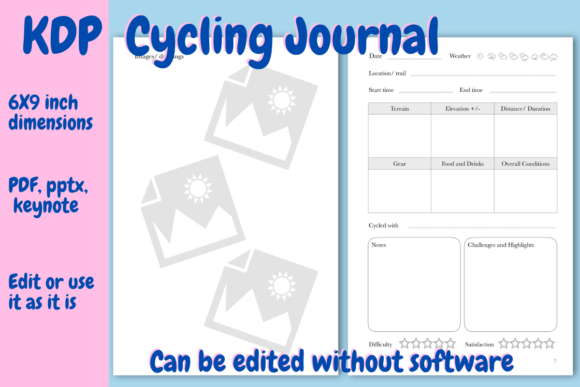
Many creators mistakenly assume that any notebook with a bicycle on the cover qualifies as a cycling journal. However, serious cyclists require specific data points to track performance and safety. A generic lined notebook fails to capture elevation gains, gear ratios, or nutritional intake. When evaluating or creating a Cycling Journal for KDP, the interior must be tailored to the activity. The ideal structure includes dedicated fields for date, water intake, starting and ending times, terrain type, elevation, distance covered, gear used, food and drinks consumed, overall conditions, challenges, highlights, and notes for future rides.
This specificity transforms a simple diary into a training log. For publishers, this distinction matters because targeted interiors reduce return rates and increase positive reviews. Readers are increasingly savvy; they check "Look Inside" features before purchasing. If the interior lacks the necessary prompts for tracking ride metrics, they will move on to a competitor. Therefore, the value lies not in the cover art alone, but in the thoughtful architecture of the recording pages.
Optimizing Page Layout for Mixed Media
A frequent oversight in low-content book design is failing to account for how users actually interact with the physical product. Cyclists often want to include visual memories alongside their written logs. A common mistake is placing image spaces and writing prompts on the same page. This creates significant usability issues. Tape, glue, and photo paper add thickness, causing the page to buckle. When a user tries to write on a surface that has been altered by adhesives, the pen skips, and the experience becomes frustrating.
The superior approach involves a split-page strategy. Dedicate the left page exclusively for visuals, such as drawing, taping photos, or attaching route maps. Reserve the right page entirely for structured text entry. This separation ensures that the writing surface remains smooth and stable, regardless of how many images are added to the facing page. For a standard 50-journey journal, this results in 100 content pages plus front matter, totaling approximately 105 pages. This layout respects the user's need for creative expression while maintaining the integrity of the data collection process.
Navigating File Formats and Editability
Sourcing or creating templates in multiple formats like PDF, PPTX, and Keynote offers flexibility, but it also introduces compatibility risks. A major misunderstanding is assuming all editable files behave identically across platforms. While a Cycling Journal for KDP in PDF is print-ready and safe, PPTX and Keynote files are intended for customization. Users planning to edit these files in Google Slides must verify element grouping and font embedding before purchasing or downloading.
If you intend to modify the journal, always test the file in your preferred software first. Some complex vector graphics or custom fonts may not translate correctly when converting from Keynote to Google Slides, leading to misaligned text boxes or missing elements. For those who do not wish to install specialized design software, confirming that the PPTX file is fully compatible with browser-based editors is a critical step. This prevents wasted time trying to fix broken layouts. Always prioritize files that have been explicitly tested for cross-platform editing if you lack access to native applications.
Managing Printing Costs and Dimensions
Profit margins in low-content publishing are dictated by page count and trim size. The 6x9 inch dimension is the industry standard for portable journals because it fits easily into hydration packs and jersey pockets. Deviating from this size can limit your audience to those who prefer desk-bound reference books rather than field guides. Furthermore, page count directly impacts the base printing cost. A 105-page black-and-white interior typically sits at a manageable production cost, often around $2.15 depending on current KDP rates.
Creators sometimes attempt to maximize perceived value by adding excessive filler pages, inadvertently pushing the book into a higher pricing tier. Conversely, reducing the page count too much can make the spine too thin for text placement, reducing shelf visibility. Sticking to a calculated length, such as 50 journeys spanning two pages each, strikes the optimal balance. Before finalizing your manuscript, always use the KDP Previewer to check for bleed issues and margin errors. Digital proofs can be deceptive; the preview tool reveals how the physical binding will affect the usable space, especially near the gutter where users need room to write comfortably.
Structuring Front Matter for Navigation
Usability extends beyond the daily logging pages. A professional Cycling Journal for KDP must include intuitive navigation. Skipping a proper Table of Contents (TOC) is a missed opportunity for enhancing user retention. Unlike a novel, a journal is a reference tool. Riders often want to revisit specific past trips to compare conditions or routes. Including two dedicated TOC pages allows users to index their trail journeys manually, linking the location name to the specific page number.
Additionally, never neglect the copyright page. Even for low-content books, asserting ownership protects your intellectual property. Simply adding your brand name establishes a baseline of professionalism and legal protection. These front matter elements should be clean and uncluttered. Over-designing the TOC or copyright page wastes valuable real estate and distracts from the journal’s primary function. Keep these sections utilitarian to maintain focus on the riding experience.
Evaluating Quality Before Commitment
Whether you are buying a template or reviewing your own proof, specific quality checks are non-negotiable. Verify that the writing prompts provide adequate space. A common error is making input fields too small for handwriting, particularly for sections like "challenges" or "notes for next time" where users tend to write more. Test the layout by printing a single sheet at actual size and writing in it with a standard pen. If the spacing feels cramped digitally, it will be unusable physically.
Also, assess the scalability of the template. If you plan to create variations, ensure the master file allows for easy duplication or deletion of pages. Right-clicking to duplicate journey spreads should be seamless. If the formatting breaks when you add pages, the template is flawed. High-quality assets are designed with modularity in mind, allowing you to adjust the journey count without rebuilding the entire document. This efficiency is crucial for entrepreneurs managing multiple SKUs or individuals customizing a personal gift.
Focusing on User Experience Over Aesthetics
Ultimately, the success of a Cycling Journal for KDP hinges on its performance in the field. Beautiful covers attract clicks, but functional interiors generate repeat customers and organic word-of-mouth marketing. Avoid the trap of prioritizing decorative elements over practical utility. Every line, box, and prompt must earn its place on the page. By focusing on correct dimensions, logical layouts, compatible file formats, and accurate cost calculations, you create a product that genuinely serves the cycling community. This user-centric approach not only improves satisfaction but also builds a sustainable foundation for your publishing efforts.