Optimizing Your KDP Interior Strategy with a Versatile Lined Journal Notebook
The landscape of self-publishing has shifted significantly toward efficiency and scalability, particularly for creators managing extensive catalogs of low-content books. Success in this arena often depends less on writing prose and more on the technical precision of your assets. A high-quality KDP Interior serves as the backbone of any publishing business, determining not only the physical quality of the final product but also the speed at which new titles can be brought to market. When utilizing a specialized Lined Journal Notebook template system, publishers can bypass repetitive formatting tasks and focus entirely on niche research and cover design.
This specific interior solution is engineered for versatility across unlimited niches. Whether targeting academic researchers, creative writers, or professionals seeking organizational tools, the foundation remains consistent: a clean, functional layout that meets Amazon’s stringent printing standards. By leveraging pre-formatted files that include both bleed and no-bleed variations, creators eliminate the most common sources of rejection during the upload process. Understanding the technical specifications and strategic applications of these interiors is essential for building a sustainable publishing workflow.
Technical Specifications and File Architecture
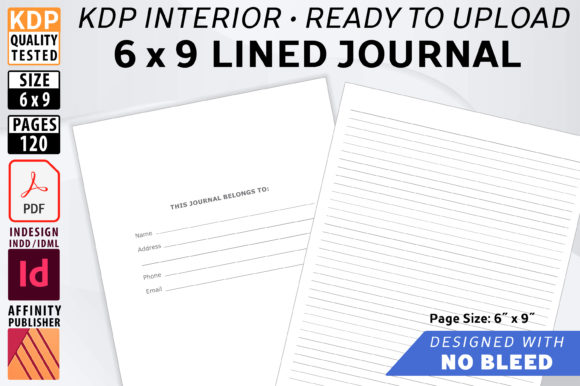
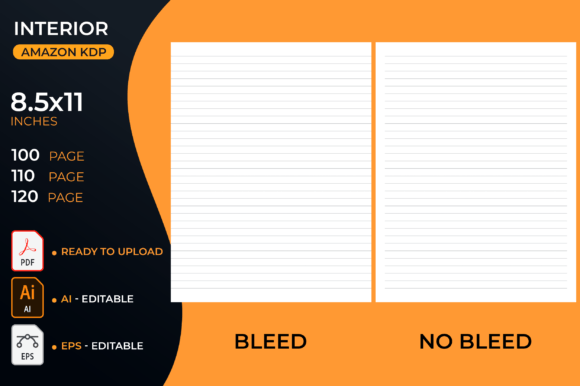
The integrity of a printed book relies heavily on correct file preparation. This lined journal KDP interior package addresses the technical complexities of print-on-demand by providing six distinct PDF files alongside editable source formats. The inclusion of three bleed and three no-bleed options covers the two primary configuration states required by Amazon KDP. Bleed settings are critical when design elements extend to the edge of the page, while no-bleed configurations maintain a safe margin for text-heavy or minimalist layouts.
The standard dimensions of 8.5×11 inches represent one of the most popular trim sizes for journals and notebooks. This size offers ample writing space for students and professionals while remaining cost-effective to print. The package includes three specific page count variations: 100, 110, and 120 pages. These increments allow publishers to test different price points and perceived values without altering the core design. For instance, a 100-page notebook might serve as an entry-level product, while the 120-page version could be positioned as a premium option within the same niche.
Beyond the ready-to-upload PDFs, the provision of AI Illustrator CC and EPS editable files adds a layer of long-term value. While the PDFs are sufficient for immediate publication, the vector-based source files enable customization. Publishers can adjust line spacing, modify header fonts, or add niche-specific prompts without rebuilding the document from scratch. This editability ensures that the asset remains useful even as market trends evolve or as specific customer feedback dictates design refinements.
Streamlining the Upload Workflow
Time management is often the limiting factor for independent publishers. Creating a compliant interior from scratch for every new title is inefficient and prone to error. This system provides 100 formatted and tested interiors that have been verified for KDP compatibility. The "tested for upload" designation is significant; it implies that margins, gutter space, and resolution have already been validated against current platform requirements. This reduces the friction between concept and live listing, allowing for rapid iteration.
The workflow facilitated by these files supports a bulk-publishing strategy. Instead of spending hours adjusting margins in word processing software, a publisher can select the appropriate page count and bleed setting, pair it with a unique cover, and upload. This efficiency is particularly valuable when exploring micro-niches where volume is necessary to capture search traffic. The ability to deploy multiple variations quickly allows for data-driven decision-making based on actual sales performance rather than speculation.
Niche Adaptation and Market Applications
A common misconception about lined journals is that they are generic commodities. In reality, their utility spans a vast array of specific user groups. The neutrality of a standard lined format makes it an ideal canvas for niche targeting. Because the interior structure is fixed, the differentiation occurs through metadata, cover design, and subtitle positioning. This separation of concerns allows creators to apply a single robust KDP Interior to dozens of distinct markets.
- Academic and Educational Use: The 8.5×11 dimension mirrors standard letter paper, making these notebooks suitable for lecture notes, lab observations, and study guides. The 120-page variant aligns well with semester-long courses.
- Professional Documentation: Nurses, therapists, and field technicians often require durable, standardized notebooks for record-keeping. A clean lined interior conveys professionalism and functionality.
- Creative Writing and Journaling: Authors and poets frequently prefer larger formats for drafting. The consistent line spacing aids in readability and manuscript estimation.
- Hobbyist Tracking: From bird watching logs to wine tasting journals, enthusiasts need structured space to record observations. The blank lined nature allows flexibility while maintaining organization.
For each of these applications, the underlying product remains the same, yet the value proposition shifts entirely based on presentation. This adaptability is the core strength of using a standardized, high-quality template. It transforms a simple notebook into a targeted tool for specific demographics without requiring custom interior design for each iteration.
Quality Assurance and Print Consistency
In the print-on-demand model, the creator never physically inspects the book before it reaches the customer. Therefore, digital quality assurance is paramount. Files that are merely "formatted" may still contain subtle errors regarding color profiles or margin safety zones. This resource emphasizes that its contents are tested specifically for KDP upload. This testing phase typically involves running files through automated previewers and checking for common pitfalls such as low-resolution vectors or incorrect bleed definitions.
Consistency across page counts is another marker of professional-grade interiors. When scaling from 100 to 120 pages, pagination and binding gutters must remain mathematically precise to prevent text drift toward the spine. Pre-tested templates handle these calculations automatically. For the end-user, this translates to a better writing experience where lines are evenly spaced and margins are comfortable. Positive reviews regarding print quality often stem directly from these invisible technical decisions made during the file preparation stage.
Strategic Considerations for Low-Content Publishing
While having access to ready-made files accelerates production, successful publishing requires strategic oversight. Relying solely on the interior without considering market fit leads to saturation. The advantage of possessing editable AI and EPS files is the ability to create derivatives. A publisher might use the base lined journal for general note-taking but modify the source file to include dotted headers for bullet journaling or shaded sections for sketch-noting. This hybrid approach leverages the efficiency of templates while introducing enough uniqueness to stand out in search results.
Pricing strategy should also be informed by the available page counts. The difference in printing cost between 100 and 120 pages is marginal, but the perceived value to the customer can be significant. Testing different page counts within the same niche can reveal optimal pricing sweet spots. Furthermore, having multiple page options allows for bundling strategies or series creation, where customers might purchase a set of matching notebooks for different purposes.
It is also vital to consider the longevity of the asset. Digital standards change, and platforms update their ingestion requirements periodically. Owning the editable source files protects your business against obsolescence. If Amazon adjusts margin requirements next year, a static PDF becomes useless. An editable AI file, however, can be adjusted and re-exported in minutes. This future-proofing aspect is a critical consideration for anyone treating KDP publishing as a long-term business rather than a short-term experiment.
Integrating Interiors into a Broader Business Model
This lined journal KDP interior functions best as part of a diversified catalog. While notebooks are excellent for cash flow due to their broad appeal, they can also serve as lead magnets or complementary products for higher-content books. An author selling a textbook might offer a matching lined journal for student notes. A coach selling a workbook might provide a companion reflection journal. The availability of professional, ready-to-use interiors lowers the barrier to creating these ecosystem products.
Ultimately, the value of this resource lies in its balance of convenience and control. It removes the technical drudgery of formatting while retaining the flexibility needed for niche specialization. For professionals, educators, and entrepreneurs entering the self-publishing space, mastering the use of standardized, high-quality interiors is a foundational skill. It shifts the focus from mechanical production to creative marketing and audience understanding, which are the true drivers of success in the modern publishing environment.