Weight Loss Journal for KDP: A Practical Guide to Customizable Tracking Templates
Creating a successful low-content book requires more than just uploading a generic template; it demands a functional tool that solves specific problems for your target audience. When developing or selecting a Weight Loss Journal for KDP, the primary value lies in its utility for tracking complex health data over time. Many creators and consumers overlook the importance of structural flexibility, assuming that any notebook with lines will suffice. However, effective weight management, bodybuilding, and macronutrient counting require specific layouts that standard journals simply cannot provide. Understanding the nuances of file formats, interior design, and printing economics is essential for producing a high-quality product that stands out in a saturated marketplace.
Beyond Basic Weight Tracking: Designing for Diverse Needs
A common mistake in this niche is designing exclusively for casual dieters while ignoring high-performance users. Athletes, bodybuilders, and individuals managing medical dietary restrictions need granular data points that go beyond simple calorie totals. If your journal lacks space for detailed macronutrient breakdowns, you alienate a significant portion of potential buyers who are often the most consistent users of tracking tools.
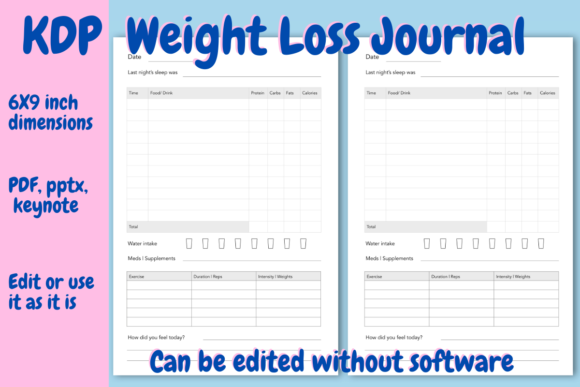
An optimized interior should include dedicated tables for recording protein, carbohydrates, and fats alongside total calories. Furthermore, holistic health tracking is increasingly important. Users benefit from sections that correlate physical intake with lifestyle factors. Including fields for sleep quality, water intake, medication, supplements, and daily mood allows users to identify patterns between their habits and their progress. For example, a user might discover that poor sleep correlates with higher carbohydrate cravings the following day. Without designated space to record these variables, the journal becomes a mere log rather than an analytical tool. Ensuring your 90 daily pages accommodate this depth of information prevents the frustration of users having to write in margins or abandon the book because it does not support their comprehensive health goals.
The Critical Role of Evaluation Pages
Consistency is vital, but so is reflection. A frequent oversight in journal design is the absence of structured review periods. Users often lose motivation because they fail to see incremental progress. To correct this, incorporate evaluation pages at regular intervals, such as every 30 days. These sections should prompt users to assess their adherence to goals, record updated measurements, and adjust their strategies based on the previous month's data. This transforms the journal from a passive record into an active coaching aid. When evaluating a template, verify that these check-in pages are distinct from daily logs and offer enough space for meaningful written reflection and numerical comparison.
Navigating File Formats and Editing Capabilities
Technical compatibility is where many creators face unnecessary hurdles. While PDF is the industry standard for final upload, relying solely on non-editable files limits your ability to customize the product for your specific brand or niche. Access to source files in PowerPoint (PPTX) and Keynote is invaluable for making precise adjustments without expensive software subscriptions.
Google Slides Compatibility: Not everyone owns Microsoft Office or Apple Keynote. Before purchasing or downloading a template, confirm that the PPTX file opens correctly in Google Slides. Some complex formatting, master slides, or proprietary fonts may break when converted. Test the file immediately upon receipt. If elements shift or tables become uneditable, the template may cause more work than it saves. A truly versatile Weight Loss Journal for KDP template maintains its integrity across platforms, allowing you to edit text, move elements, and resize tables freely in a browser-based environment.
Efficient Page Management: Customization should be intuitive. Look for templates where pages are set up as individual slides or easily duplicable masters. You should be able to right-click and duplicate daily tracking pages or delete unnecessary sections without disrupting the entire document flow. If adding ten extra macro-tracking pages requires rebuilding the layout from scratch, the template is inefficient. Efficient design respects your time and allows for rapid iteration based on customer feedback or market trends.
Understanding Print Costs and Dimensions
Profitability hinges on understanding the relationship between page count, trim size, and printing costs. For a 6x9 inch journal, the 99-page structure described here typically incurs a printing cost of approximately $2.15 USD. This is a crucial metric. Adding excessive blank pages or expanding the evaluation sections unnecessarily can push the page count into a higher pricing tier, eroding your royalty margin.
Always use the KDP Previewer before finalizing your project. Screen resolution differs significantly from print output. Margins that look adequate on a monitor may be too close to the gutter in physical form, especially with a 99-page binding. Verify that writing spaces are large enough for handwriting and that tables align perfectly when printed double-sided. Testing prevents costly reprints and negative reviews regarding usability.
Avoiding Content and Legal Pitfalls
When customizing your journal, pay close attention to the front matter. The title page and copyright page set the professional tone. Ensure the copyright page clearly states your brand name and includes appropriate disclaimers. Since this journal involves health tracking, it is prudent to include a note that the book is for informational and organizational purposes only and does not constitute medical advice. Overlooking this detail can expose you to liability or result in content rejection during the review process.
Additionally, avoid the temptation to overstuff the initial goal-setting pages. While enthusiasm is high at the start, users can feel overwhelmed if confronted with ten pages of questionnaires before they ever log a meal. One focused page for initial goals and measurements is usually sufficient. It provides a baseline without creating friction. Remember that the user’s primary interaction is with the daily logs; keep the setup phase streamlined to encourage immediate adoption.
Evaluating Quality Before Purchase or Upload
Whether you are buying a template to resell or creating one for personal use, apply a critical eye to the layout density. White space is not wasted space; it is necessary for readability. Dense text and cramped tables lead to user fatigue. Check that the font choices are legible at small sizes and that there is adequate contrast between text and background elements. Gray-scale printing can sometimes wash out light colors or thin lines, so opt for bold, clear table borders.
Finally, consider the long-term utility of the asset. A high-quality Weight Loss Journal for KDP template is an investment that should yield multiple products. Can you adapt the same macro-tracking layout for a fitness journal? Can the evaluation pages be repurposed for a business productivity tracker? Choosing flexible, well-structured source files maximizes your return on investment and ensures you can respond quickly to evolving market demands. By prioritizing functionality, technical compatibility, and economic viability, you create a resource that genuinely serves the user’s journey toward better health.